Open any popular expense tracker on the App Store or Play Store. Within two screens, it's asking for your phone number, your bank credentials, sometimes even your government ID. Before you've logged a single transaction, the app already knows more about you than it needs to.
We built Savr because we were tired of that trade-off. You shouldn't have to hand over your financial life just to track where your money is going.
Where your data actually lives
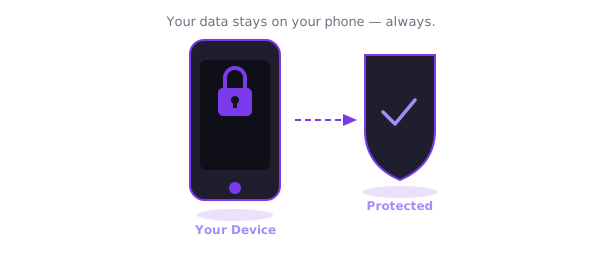
When you add an expense in Savr — whether it's $4 for a coffee or $1,400 for a phone payment — that record is written to a SQLite database stored directly on your device. Not on our servers. Not in the cloud. On your phone.
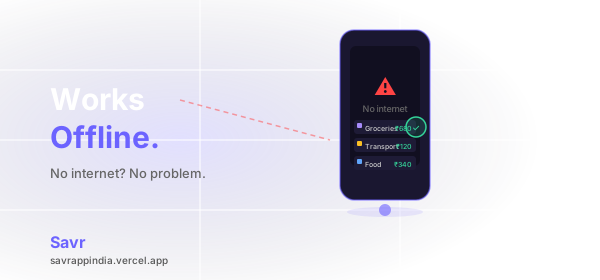
This is called offline-first architecture. It means the app works whether you have internet or not, and more importantly, it means we physically cannot access your spending data — because it was never sent to us in the first place.
What Savr actually uses the internet for
We use Google Sign-In to create your account. That's it. We store your name, email address, and profile picture so the app knows who you are. Your transactions, budgets, categories, and reports never leave your device.
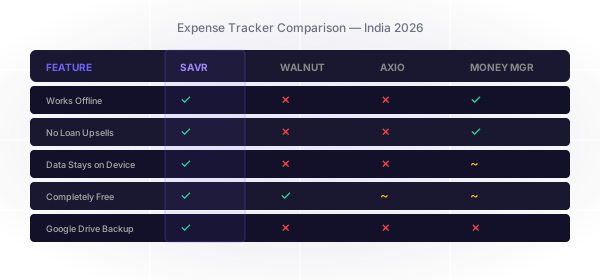
No syncing to our database. No analytics on your spending patterns. No selling your data to lenders or insurance companies. Many fintech apps have built entire business models around that last one — we want no part of it.
Google Drive backup — yours, not ours
If you switch phones or do a factory reset, you'd normally lose everything. That's why Savr includes an automatic Google Drive backup — but with one important difference from how most apps handle it.
The backup file goes into your Google Drive account, inside a folder only your Google account can access. Savr never sees it. We don't have permission to read it. It belongs to you entirely, the same way your photos and documents do.
If you'd rather keep everything 100% offline with no backup at all, you can turn it off in Settings. Your choice, your data.
Why most finance apps don't do this
Storing data on-device is harder to build and impossible to monetise the way cloud storage is. When your data lives on a company's server, that company can run analytics on it, build advertising profiles, or share patterns with financial partners. That data has real commercial value.
When your data lives on your phone, it has zero commercial value to anyone except you. That's exactly why we built it this way.
No tracking, no loan upsells
Many popular finance apps will send you a push notification offering a personal loan or a credit card within days of signing up. That's not a coincidence — those apps analyse your spending to identify when you're financially stretched, then sell you debt at that exact moment.
Savr doesn't do this. We don't know your spending patterns. We can't. And we don't want to.
What we do collect — and why
We believe in being upfront. Here's the complete list of what Savr collects:
- Your name, email, and profile picture via Google Sign-In
- Your device model and Android version (for crash reporting and compatibility)
- Your app version (so we know if you're on an outdated build)
- Your last active timestamp (to understand general usage, not behaviour)
That's the entire list. No location. No contacts. No transaction data. No spending history.
Privacy shouldn't be a premium feature
A lot of apps offer a "privacy mode" or "local-only mode" as part of a paid tier. We think that's backwards. Privacy is the default in Savr — not something you unlock by paying a monthly subscription.
Savr is free. Your data is yours. That's the deal, and it doesn't change.
Download Savr free on Google Play — no data harvesting, no loan upsells, no surprises.